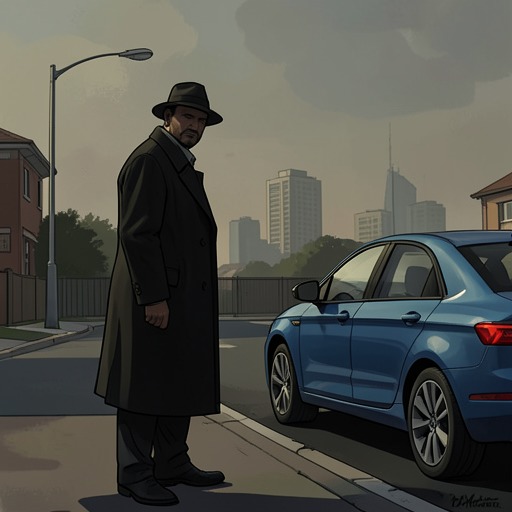
Yngve Morsand
The SonYngve Morsand is a shipowner and the husband of Kjersti Morsand, whose murder becomes a central case in the plot. At first he appears to be a wealthy, plausible suspect who has been cleared by evidence implicating Sonny Lofthus. The later revelation is more disturbing: Yngve did kill Kjersti, but he also paid a criminal network to ensure that someone else would take the blame. His case shows how an apparently straightforward murder investigation can be engineered from inside the systems meant to establish the truth.
Identity and Background
Yngve is identified as a shipowner and as the man with an eyepatch, a detail that makes him recognizable from newspaper coverage. His family name is attached to a large, well-furnished house. When Sonny is given information about that house, the unusual circumstances of the apparent break-in stand out: the alarm was off and the front door was unlocked. Those details later belong to the staging of a crime, not simply to the description of a wealthy household.
Yngve is Kjersti’s husband. Before her death, she had confided to a friend that he accused her of having an affair and threatened to kill her. Her friend also reported that Kjersti was frightened, in part because she had met someone else and was considering leaving the marriage. The threatened husband, the possible infidelity, and the threatened departure gave investigators a clear conventional motive. They did not, however, explain why the rest of the evidence pointed toward Sonny.
The Murder and Its Frame-Up
Yngve did not merely become a suspect after Kjersti was killed; he had wanted her killed and insisted on carrying out the murder himself. Hugo Nestor had initially understood Yngve’s request as an attempt to hire a hit man. Yngve instead wanted the pleasure of committing the crime, while asking Nestor’s organization to arrange for another person to be blamed. The arrangement cost three million kroner. Nestor regarded the payment as a price for a life sentence, and Yngve agreed.
The conspiracy depended on more than planting a clue after the fact. Nestor’s people coordinated with Arild Franck to arrange Sonny’s day release and control where he would be taken. A trusted, corrupt prison officer was assigned to accompany Sonny. This gave the conspirators a way to place him near the crime and make the circumstances appear to support the case against him. When Simon Kefas later questioned the strand of hair attributed to Sonny and raised the possibility that it had been planted, he also recognized that a prison officer at Staten would have had to assist with a release designed to implicate him. The attempted suppression of those questions shows the frame-up reaching beyond the criminals directly involved.
The crime also depended on controlling what investigators would infer from the scene. Kjersti’s reported fear and Yngve’s apparent motive made him a natural suspect, but DNA attributed to Sonny shifted attention away from the husband. A broken medicine cupboard and Yngve’s claim that sleeping tablets had gone missing supplied another detail to examine; investigators questioned why a man with access to hard drugs would need a small quantity of sleeping pills. Such inconsistencies did not immediately undo the apparent case against Sonny, but they exposed the strain between the official explanation and the facts.
Exposure and the Network Behind Him
Yngve’s scheme forms part of a larger criminal operation in which police and prison access can be used to obstruct investigations. Nestor describes the danger posed by several possible outcomes: Sonny might continue killing people connected to the network; if arrested, he could confess and reveal the real perpetrators in earlier cases; or, if Sonny did not confess, Yngve might be arrested for Kjersti’s murder and reveal what had happened. In Nestor’s calculation, the only safe course was to find and kill Sonny. Yngve’s attempt to avoid suspicion therefore helped create the threat that the conspirators later sought to eliminate.
The network’s methods are also visible in the way it connects private wealth to institutional corruption. In a separate confrontation, Simon accuses Iver Iversen and Iversen Property of helping the Twin launder money from drugs and trafficking in exchange for fictitious tax losses worth hundreds of millions of kroner. That accusation establishes the wider financial machinery through which the Twin’s organization operated; Yngve’s payment to Nestor is a different transaction, but it likewise shows criminal services being purchased as if they were ordinary business.
Later Appearance and Consequences
Yngve later appears alongside the Twin and Iver Iversen. He identifies himself to Iver and offers condolences, while the Twin explains that they are using Yngve’s house outside Drammen as a trap for Sonny, who is expected to try to kill Iver. Yngve treats the prediction as a wager, betting that Sonny will not come. The house that had figured in the earlier deception has thus become a planned site for another confrontation.
After a reported shooting at the house, Yngve tells police that he knows nothing and is staying at a hotel in Oslo; he says the last time he saw the car it was in his garage. Police in Drammen find nine 9 × 19 mm Luger bullets in the floorboards, arranged in a fan-shaped spread, and identify Evgeni Zubov as the passenger in the car. The available account does not establish the full outcome of the trap or Yngve’s ultimate fate. It does show that his house remains bound to the violence and deception surrounding Sonny, even after Yngve has tried to position himself as a detached observer.
Narrative Role
Yngve’s role is defined by the gap between motive and evidence. His threats toward Kjersti and her fear provide an intelligible reason to suspect him, while the staged circumstances and planted link to Sonny redirect the investigation. The deception is not an abstract failure of detection: it is constructed through a paid agreement, a corrupt prison officer, a manipulated release, and pressure to hush up questions about the evidence.
His character also sharpens the novel’s concern with the limits of formal justice when institutions are compromised. Yngve uses money to separate the act from its apparent perpetrator, while Nestor’s network exploits the very procedures meant to locate and punish a killer. The eventual revelation restores the central fact concealed by the frame-up: Sonny was made to appear guilty of Kjersti’s murder, but Yngve had arranged the blame precisely because he wanted to commit it himself.